Your apps have moved in. Who's paying the rent?
When distribution gets bigger than the product, what is a product? Notes on agents, super apps, Tokopedia, and what the middleman always takes.
 Image: Anthropic, November 2026.
Last week Anthropic announced that apps can now open inside Claude, and Claude can work in them. Not a link out to the app, and not a summary of what the app said: the app itself, running in the conversation, with the agent working alongside you.
My first reaction was “wow.” My second was that I’ve seen this kind of shift a few times before.
The front door keeps moving
Every decade or so, the place where the user starts moves.
In the 1990s you went to a website. Around 2008 you opened an app. In 2022 you started asking a chatbot. Now the apps are moving into the chat.
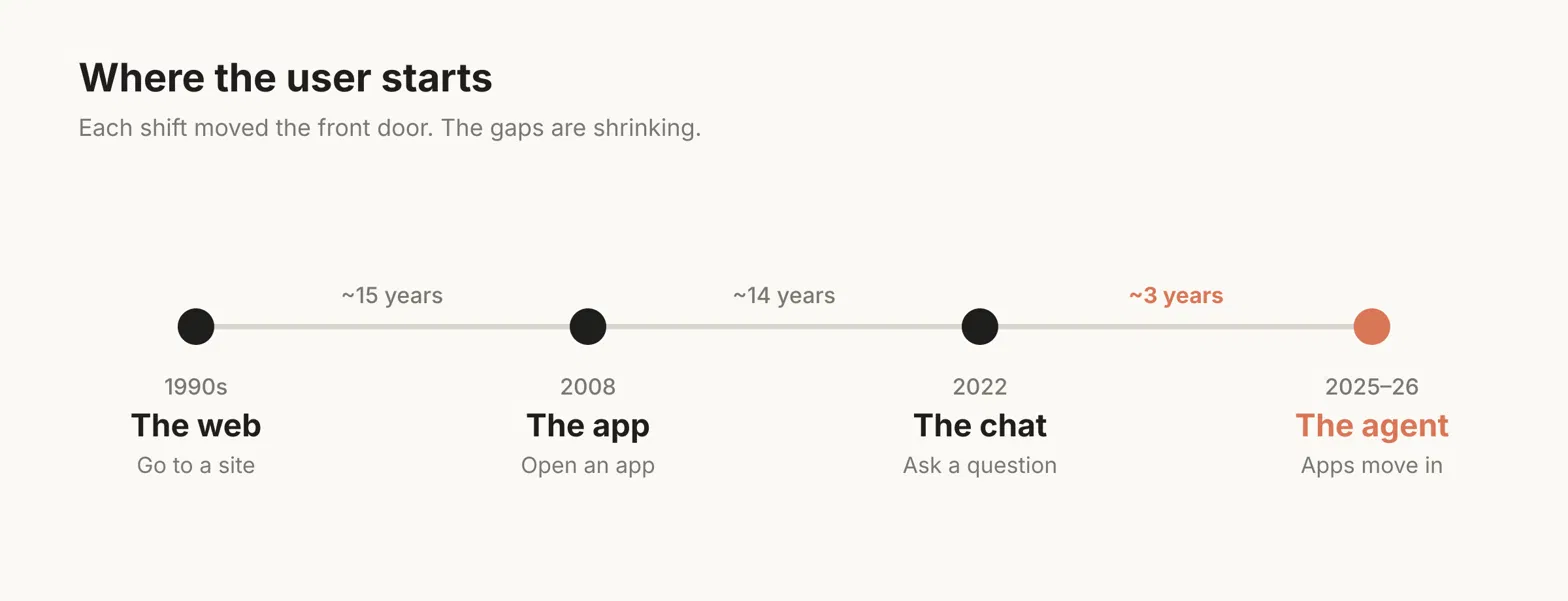
I’d argue chat and “apps moving in” aren’t two shifts. They’re one, in the same way the iPhone (2007) and the App Store (2008) were one. Chat was the new surface. Apps moving in is the distribution layer that makes the surface stick. Without it, chat is a clever answer box that sends you back out to do the actual work somewhere else. With it, the work happens where you already are.
What really stands out is the speed. Web to apps took about fifteen years, apps to chat about fourteen. Chat to apps-inside-the-agent took about three. OpenAI put apps into ChatGPT in October 2025. Claude got interactive connectors in January 2026, and full embedded apps in November. Businesses got a decade to adapt to mobile. They won’t get that this time.
So what is a product?
If the app now lives inside someone else’s interface, it’s fair to ask what the product actually is.
Software was always the odd one out here. For most of history, a product was the outcome. A courier gets your parcel there. A lawyer handles your case. Nobody cares what the front desk looks like. Software merged the outcome with the interface, because for thirty years the interface was the only way in. The app was the product.
Agents pull the two apart again. When you strip the interface away, a product comes apart into a few layers:
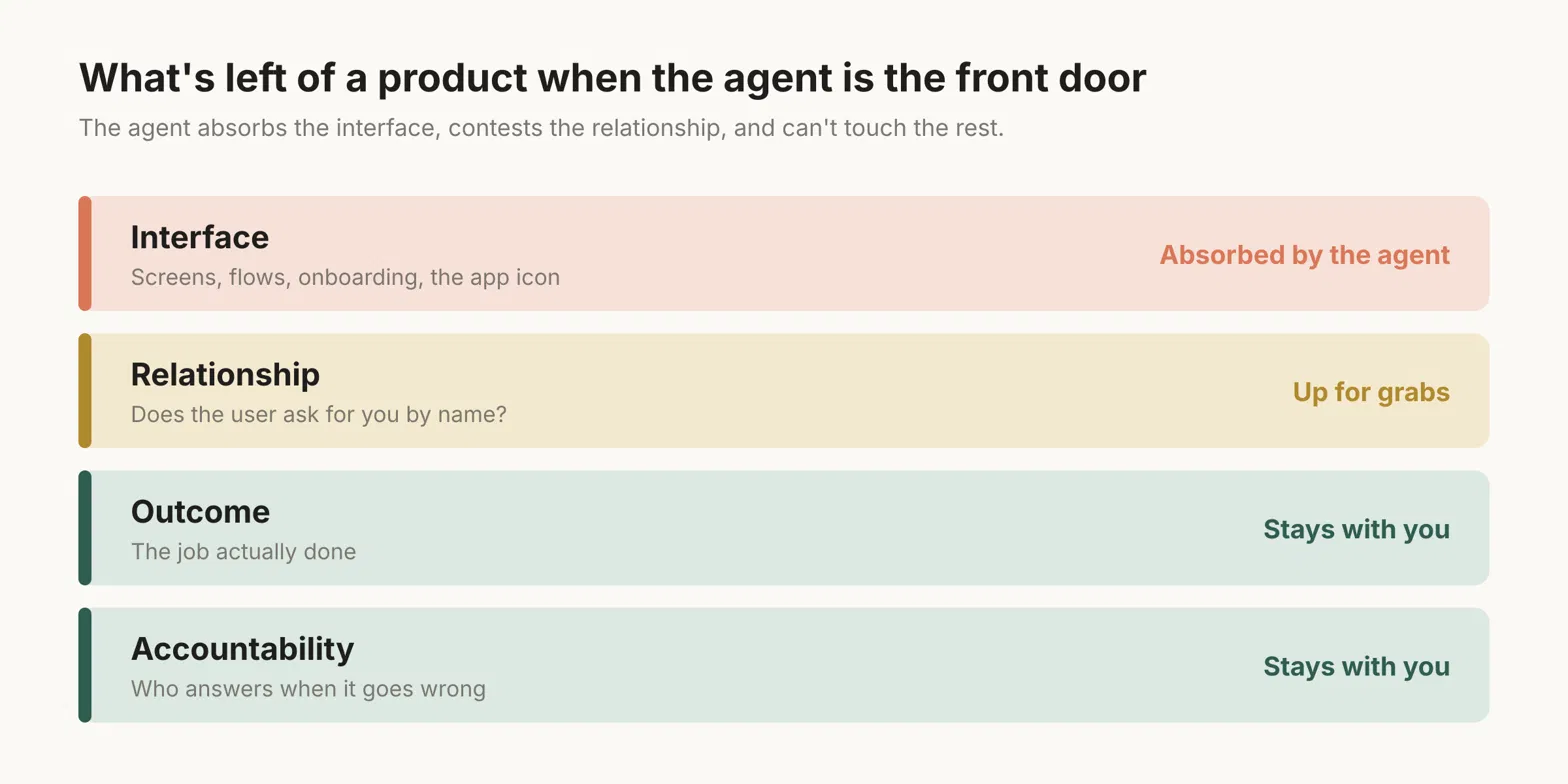
- Interface: the screens, flows, onboarding and app icon. The agent absorbs this.
- Relationship: whether the user asks for you by name. This is up for grabs.
- Outcome: the job actually done. This stays with you.
- Accountability: who answers when it goes wrong. This also stays. An agent can’t take responsibility for a late delivery or a wrong insurance payout, and I think this is underrated as a moat.
Which raises the question this post is really about: if the product is the service, does it matter where the user reaches you from?
We’ve tried owning the front door. It mostly didn’t work.
The last generation’s answer to the distribution question was the super app. The bet was simple: become the place everyone starts, and bundle everything behind it.
Outside China, it has mostly failed.
- Paytm in India was the poster child. It has been shedding parts of its super app since its payments bank was suspended, and has refocused on payments.
- Tata Neu, backed by one of India’s biggest conglomerates, missed its first-month sales target, and its CTO left four months after launch.
- PayPal tried a super-app redesign in 2021–22 and then retreated to its core payments business.
- X promised an “everything app” and still hasn’t shipped the payments and banking that would make it one.
The closest case to home, and the one that made this click for me, is Tokopedia.
Tokopedia was Indonesia’s flagship e-commerce destination, the “To” in GoTo. In December 2023, TikTok bought 75.01% of it for $840 million and folded TikTok Shop Indonesia into it. The shopping still happens inside the TikTok app, because that’s where the attention is. GoTo took a $5 billion goodwill writedown.
The destination became the back end behind somebody else’s front end. Tokopedia didn’t lose to a better marketplace. It lost to whoever owned the moment someone decides they want something.
That’s what agents threaten to do to almost everyone. And you can’t win this round by becoming a bigger destination, because the destination is exactly what’s being made irrelevant.
The middleman always gets paid
Here’s what history says about what happens when distribution gets bigger than the thing being distributed: whoever owns the front door gets a cut. Every time.
What changes is the currency.
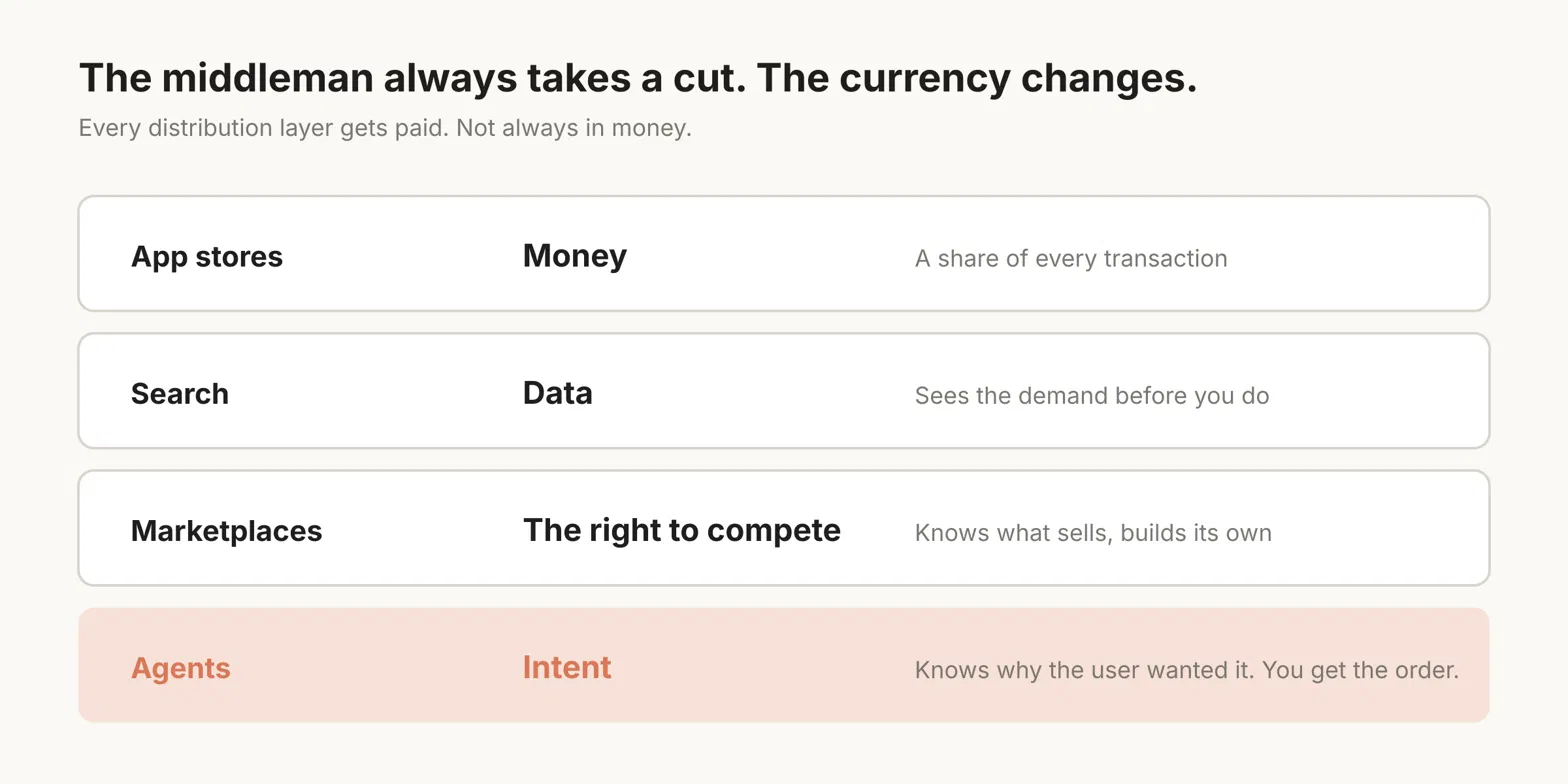
- App stores take money. A share of every transaction, the famous 30%.
- Search takes data. Google sees the demand before you do, then sells it back to you as ads.
- Marketplaces take the right to compete. Amazon knows what sells, and builds its own version.
- Agents take intent.
That last one is new, and I think it’s the most valuable currency so far. When a user asks an agent to “send this to my mom in Bandung by tonight,” the agent knows why. It knows what else was considered, what the user cares about (speed? price?), and what they’ll probably want next. The service provider gets the order. The agent keeps the context.
Hotels learned this lesson a long time ago. A hotel is a pure service you can book from anywhere, and booking platforms still take double-digit commissions on the rooms they sell. That’s why every chain pushes loyalty programs and “book direct” discounts. They aren’t paying to sell rooms. They’re paying to own the relationship.
Protocol or platform?
To be fair, “the middleman always takes a cut” isn’t strictly true. Protocols don’t. Email, the open web and SMS move your product to users and nobody gets paid for the routing.
And the plumbing under this shift is, in fact, a protocol. Apps inside Claude run on MCP Apps, an open extension that lets an app built once run in any AI product that supports it, not just Claude. That’s good news: nobody owns the pipe.
But nobody needed to own the pipe. The web was a protocol too, and Google still ended up taking the cut, because Google owned the starting point. The pipe can be open while the session isn’t. Whoever the user talks to first decides which app gets called, and Claude already suggests apps based on the context of the conversation. That suggestion is the new search result, and it’s the new shelf placement.
Where this leaves a company like Paxel
I work at Paxel, a logistics company, so I’ve been looking at this from the side that gets routed to.
The honest version of the argument isn’t “logistics can’t fit in the agent channel.” An agent can obviously book a courier: it takes the request, calls the API, done. The order fits the channel. The delivery doesn’t.
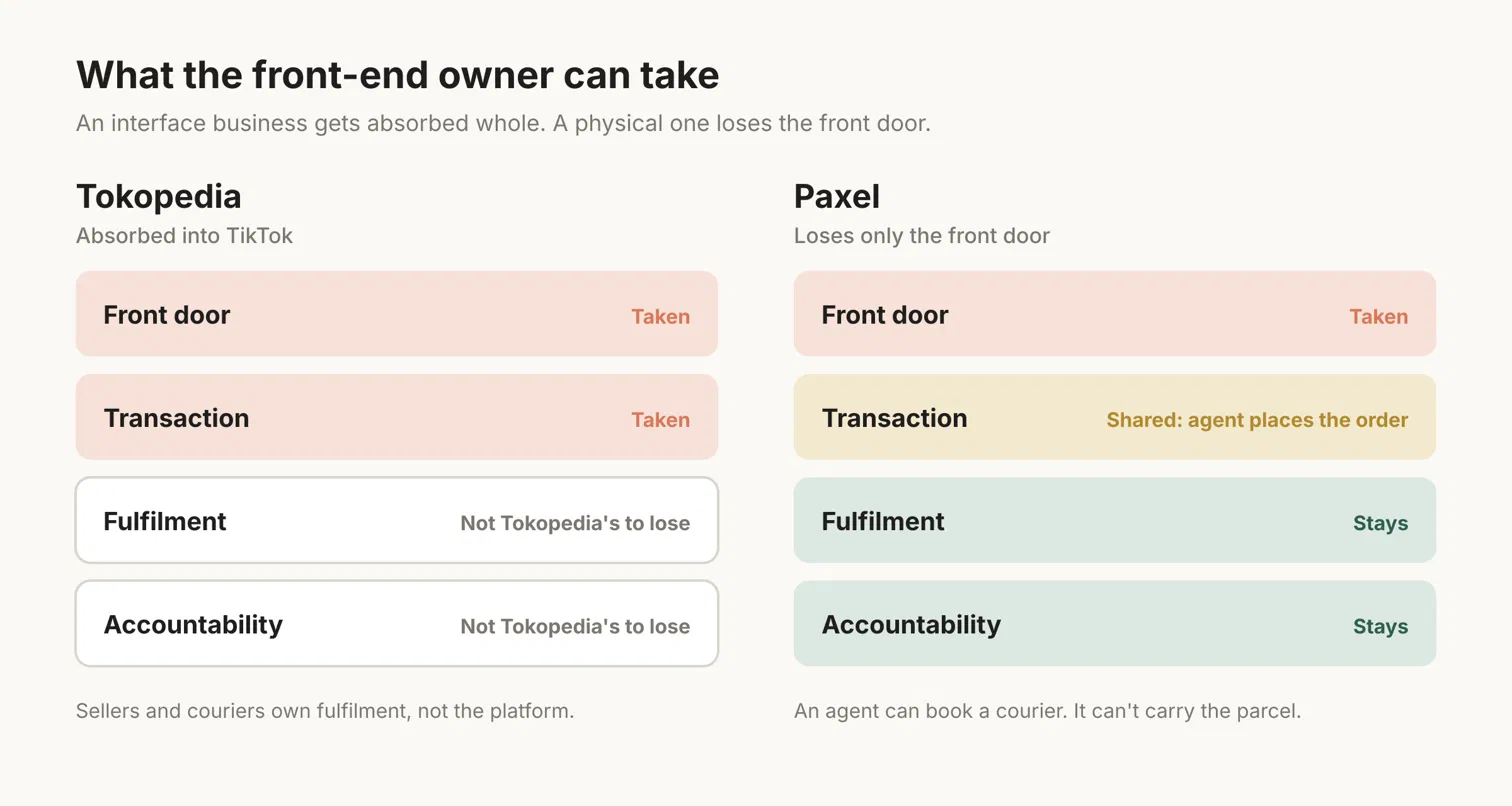
An agent can’t pick up the parcel, keep it in a locker, get it across Jabodetabek before dinner, or answer for it when it’s late. Everything after the click is physical, and everything physical stays with whoever owns the fleet. Tokopedia was mostly an interface, so it got absorbed whole. A logistics company only loses the front door.
That doesn’t mean nothing is lost. The front door is where the relationship lives. A user who says “send it with Paxel” to their agent is a customer. A user who says “send it the cheapest way” is a price comparison. Brand used to mean the icon on someone’s home screen. In an agent world, brand is the word the user puts in their instructions, or the default they set once and forget. Generative engine optimization (GEO), the AI-era cousin of SEO, can help you get picked when the user doesn’t name anyone. Getting them to name you in the first place is still old-fashioned brand work.
The question to ask
So, does it matter whether users come to you directly?
For delivering the service, less and less. For the economics, more than ever. The front door doesn’t disappear. It moves to someone else, and they’ll be paid one way or another.
The question I’d ask about any business right now isn’t “how do we get users to come to us?” It’s:
What are you paying your distribution in, and do you know the rate?
Most founders I know can tell you their payment processing fees to the decimal point. Very few have counted what they’re giving away in data, in intent, and in knowing who their customer actually is.
That second bill is about to get a lot bigger.